Skip to product information
1 of 3

Rajasthan Desert Tour

Rajasthan Desert Tour

Journey across the royal heartland of India, from the monuments of Delhi and Agra through the painted cities of Rajasthan. Explore Jaipur's palaces, Jodhpur's blue lanes, Jaisalmer's golden fort, Bikaner's camel country, and the art-adorned havelis of the Shekhawati region.

Duration
11 Nights / 12 Days
Tour Type
Cultural, Heritage & Desert Tour
Best Time to Travel
July to April
Regular price $2,750.00 USD
Regular price Sale price $2,750.00 USD
Sold out
View full details

12-Day Rajasthan Desert Tour & Heritage Package

A Grand Journey Across Royal Rajasthan

Rajasthan occupies the northwest corner of India and contains some of the subcontinent's most dramatically beautiful landscapes and architecture. For centuries, the state was ruled by the Rajput clans — warrior-kings who built imposing hill forts, lavish palaces, and intricately decorated stepwells and temples. The legacy of that era is visible everywhere: in the amber-coloured sandstone of Jaisalmer, the blue-washed walls of Jodhpur, the terracotta-pink façades of Jaipur, and the brilliant frescoes that cover the merchant havelis of Mandawa.

This 12-day tour is designed to move through that legacy at a pace that allows genuine engagement — not merely ticking off monuments, but spending enough time in each place to absorb its distinct atmosphere, meet its people, and understand the history that shaped it. The itinerary begins in Delhi and Agra to provide the Mughal context that sits alongside the Rajput story, before entering Rajasthan proper and traversing it from east to west and back again.

Delhi & Agra: The Mughal Foundation

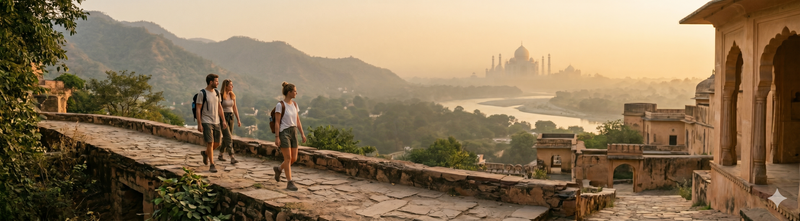
The tour opens in Delhi, India's capital and one of the world's great historic cities. A day here sets the stage with landmarks such as Humayun's Tomb, Qutub Minar, Old Delhi's Jama Masjid, and the ceremonial avenues of Lutyens' New Delhi. From Delhi, the route heads south to Agra and the Taj Mahal — arguably the finest building of the Mughal Empire and an essential reference point for understanding the art and architecture you will encounter throughout Rajasthan.

Jaipur: The Pink City

Jaipur is Rajasthan's capital and most visited city — and for good reason. The old walled city, painted a uniform terracotta pink since 1876 in honour of a royal visit, contains the magnificent Amber Fort, the City Palace complex, the five-storey Hawa Mahal (Palace of Winds), and the Jantar Mantar astronomical observatory. The city's bazaars — selling everything from precious gems and hand-block-printed textiles to traditional lac bangles — are among the most rewarding shopping streets in India. En route from Agra, the tour pauses at Fatehpur Sikri (Akbar's abandoned Mughal city) and the stunning Chand Baori stepwell at Abhaneri.

Pushkar: A Sacred Desert Town

Pushkar is one of Hinduism's most sacred pilgrimage sites, built around a small lake said to have been created when Lord Brahma dropped a lotus flower to earth. It is home to one of the very few temples dedicated to Brahma in the world. The town has a distinct character — small, compact, and deeply spiritual, yet also cosmopolitan from decades of traveller presence. The ghats around the lake, the flower markets, and the narrow lanes lined with temples and small shops make Pushkar a memorable half-day or full-day stop between Jaipur and Jodhpur.

Jodhpur: The Blue City

Jodhpur is Rajasthan's second-largest city and one of its most visually arresting. The old city spreads out below the immense Mehrangarh Fort — one of the largest and best-preserved forts in all of India, perched on a 125-metre-high rock with sweeping panoramic views. Below the fort, the densely packed lanes of the old city are famously washed in shades of blue — originally a colour associated with Brahmin homes, now spread across the neighbourhood and visible dramatically from the fort walls above.

Jaisalmer: The Golden City

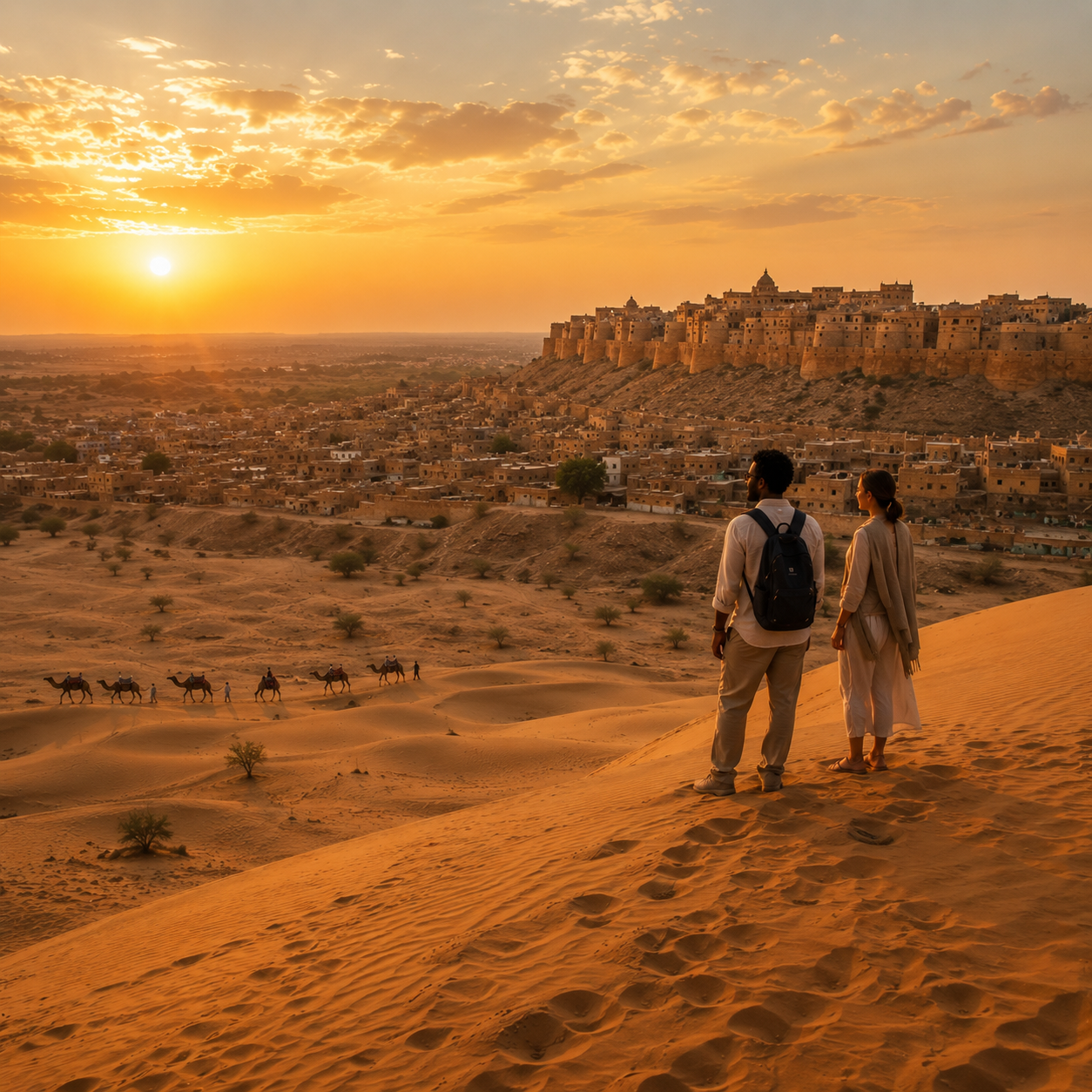
Jaisalmer stands at the edge of the Thar Desert in western Rajasthan, and it is unlike any other city in India. The entire old city — including a living fort that still houses thousands of residents — is built from golden-yellow sandstone that glows at sunrise and sunset in spectacular fashion. The Jaisalmer Fort is a UNESCO World Heritage Site and one of the few "living forts" in the world. Beyond the fort, the dunes of Sam (approximately 40 km from Jaisalmer) offer the classic Thar Desert landscape — and an optional camel safari at sunset is one of the most memorable experiences on the entire tour.

Bikaner & Mandawa: Camel Country and Painted Havelis

Bikaner, in north-central Rajasthan, is known for its Junagarh Fort — a remarkably well-preserved palace complex that was never conquered — and for the Karni Mata Temple at nearby Deshnok. Mandawa, in the Shekhawati region, is the final major stop before Delhi. Shekhawati was historically a prosperous trading region, and the wealthy merchants who lived here commissioned extraordinary frescoes to decorate their havelis — vivid depictions of Hindu mythology, royal scenes, and increasingly (as trade routes evolved) European inventions like trains, telephones, and aeroplanes. Mandawa is the finest base from which to explore this open-air gallery.

Designed for Travellers Seeking Depth

This tour is ideal for first-time visitors to Rajasthan who want a thorough and well-paced overview of the state, as well as returning travellers looking to explore beyond the standard Jaipur–Jodhpur–Jaisalmer circuit. With private transport, expert local guides at each destination, and accommodation in well-selected hotels, this journey prioritises comfort and cultural depth equally.

Frequently Asked Questions

Is this tour suitable for families with children?

Yes. The itinerary is family-friendly with wide appeal across age groups. Forts, camel safaris, and the colourful bazaars are particularly engaging for children. Child-friendly accommodation can be arranged on request.

Can we customise the itinerary?

Yes. Any destination, duration, activity, or accommodation can be adjusted. We can also extend the tour to include Udaipur or other parts of Rajasthan. Contact us to discuss your preferences.

How hot does it get during the tour season?

Rajasthan can be very hot between May and July, which is why the tour runs from April to July, avoiding the peak summer heat. October to March is the most comfortable period. July to September is the monsoon season with occasional rain but lush landscapes and fewer crowds.

What's the refund policy?

Full refund for cancellations 30+ days before departure. 50% for 15–30 days. 25% for 7–14 days. Non-refundable within 7 days of departure.

Do you provide vegetarian meals?

Yes. Vegetarian meals are available at all hotels and restaurants. Rajasthan has a strong tradition of vegetarian cuisine, dal baati churma and other local dishes are predominantly vegetarian. Please inform us at booking.

What languages are guides available in?

English and Hindi throughout. French, Spanish, and German-speaking guides are available on request with advance notice.

Day 1: Arrive in Delhi

Highlights: Airport arrival, hotel check-in, orientation, rest

Arrive at Indira Gandhi International Airport, New Delhi. You will be met by our representative and transferred by private air-conditioned vehicle to your hotel. Check in and take the rest of the day to rest and recover from your journey. Depending on your arrival time, take a short walk in your neighbourhood to get your first impressions of Delhi. Your guide will meet you in the evening to brief you on the full itinerary ahead.

End of day: Overnight in Delhi.

Day 2: Agra — Taj Mahal & Agra Fort

Highlights: Taj Mahal at sunrise, Agra Fort (UNESCO), marble inlay craft workshop

Depart Delhi early morning for Agra (approximately 3–4 hours by road or expressway). Arrive in time for the iconic Taj Mahal sunrise visit — the best light for photographs and the coolest part of the day. Your guide will walk you through the history of Emperor Shah Jahan's monument to his wife Mumtaz Mahal, detailing the extraordinary craftsmanship and symbolism embedded in the structure. After breakfast, visit Agra Fort — a massive UNESCO World Heritage red sandstone fortification that served as the principal residence of the Mughal emperors. In the afternoon, visit a local marble inlay workshop where artisans demonstrate the pietra dura technique used in the Taj Mahal's decorative panels.

End of day: Overnight in Agra.

Day 3: Agra — Fatehpur Sikri — Abhaneri — Jaipur

Highlights: Fatehpur Sikri (UNESCO), Chand Baori Stepwell at Abhaneri, arrive Jaipur

Depart Agra after breakfast with two significant stops on the way to Jaipur. First, visit Fatehpur Sikri — Akbar's meticulously planned Mughal capital, built in 1571 and abandoned within two decades due to water scarcity. The red sandstone complex is remarkably well preserved, with the Diwan-i-Khas, Jodha Bai's Palace, and the Buland Darwaza all outstanding examples of Mughal architecture at its height. Continue to Abhaneri to see the Chand Baori — one of the largest and deepest stepwells in India, with 3,500 narrow steps descending in perfect geometric symmetry to the water level below. Arrive in Jaipur by evening.

End of day: Overnight in Jaipur.

Day 4: Jaipur — The Pink City

Highlights: Amber Fort, Hawa Mahal, City Palace, Jantar Mantar (UNESCO), local bazaars

A full day to explore Jaipur with your guide. Begin at the Amber Fort — a stunning hilltop complex of Rajput palaces and courtyards with intricate mirror-work interiors and sweeping views over the valley. Back in the city, visit the famous five-storey Hawa Mahal (Palace of Winds) — built to allow ladies of the royal household to observe street life unseen through its 953 small windows — and the City Palace complex, home to a museum of royal artefacts, costumes, and weapons. Jantar Mantar, an 18th-century astronomical observatory built by Maharaja Jai Singh II, contains the world's largest sundial and is a UNESCO World Heritage Site. Spend the late afternoon in the vibrant bazaars of Johari Bazaar and Bapu Bazaar.

End of day: Overnight in Jaipur.

Day 5: Jaipur to Pushkar

Highlights: Pushkar Lake and ghats, Brahma Temple, local bazaars, rose gardens

After breakfast, drive from Jaipur to Pushkar (approximately 2.5 hours). Pushkar is one of Hinduism's oldest and most sacred pilgrimage cities, set around a small lake said to have been created by Lord Brahma. Visit the Brahma Temple — one of the very few temples in India dedicated to Lord Brahma — and walk the 52 ghats that line the sacred lake. Pushkar's bazaars are small but characterful, known for silver jewellery, Rajasthani clothing, and rose products (the town is famous for its rose gardens, which produce rose oil and rose water exported across India). The town's spiritual calm and compact scale make it a welcome contrast to the busier cities on the route.

End of day: Overnight in Pushkar.

Day 6: Pushkar to Jodhpur

Highlights: Drive through Rajasthan countryside, Mehrangarh Fort, old city blue lanes, Jaswant Thada

Depart Pushkar after breakfast for Jodhpur (approximately 4–5 hours). Arrive in the afternoon and head straight to the unmissable Mehrangarh Fort — one of the largest and most imposing forts in India, perched 125 metres above the city on a sheer rocky outcrop. The fort's museum contains an outstanding collection of royal artefacts including palanquins, armour, paintings, and the elaborately decorated royal chambers. From the fort walls, the view over the old blue city is extraordinary. After the fort, visit the elegant Jaswant Thada — a white marble memorial cenotaph built in 1899 — and take a walk through the narrow lanes of the old city with its famous blue-washed houses.

End of day: Overnight in Jodhpur.

Day 7: Jodhpur to Jaisalmer

Highlights: Drive through Thar Desert landscape, arrive Jaisalmer Fort, sunset at Gadisar Lake

After breakfast, depart Jodhpur for Jaisalmer (approximately 4.5–5 hours). The drive itself is part of the experience — crossing through increasingly arid and open Thar Desert terrain, with small villages and camel herders along the way. Arrive in Jaisalmer by early afternoon. Check into your hotel and begin exploring the Jaisalmer Fort — a UNESCO World Heritage Site and one of the few fully inhabited forts in the world. The golden sandstone fort contains palaces, Jain temples, havelis, and a lively marketplace within its walls. In the evening, visit Gadisar Lake — a historic reservoir just outside the city walls — for a peaceful sunset walk.

End of day: Overnight in Jaisalmer.

Day 8: Jaisalmer — Desert Exploration

Highlights: Patwon Ki Haveli, Sam Sand Dunes, camel safari at sunset, desert camp evening

Spend the morning exploring Jaisalmer's remarkable havelis — the finest of which is Patwon Ki Haveli, a cluster of five interconnected mansions built in the 19th century and covered in extraordinarily detailed sandstone carvings. In the afternoon, drive out to the Sam Sand Dunes (approximately 40 km from Jaisalmer) — the most accessible and dramatic dune landscape in the Thar Desert. Arrive in time for a camel safari at sunset across the dunes, one of the most atmospheric experiences in Rajasthan. Enjoy dinner and folk music at a desert camp before returning to Jaisalmer or spending the night under the stars at the camp (upgrade option available).

End of day: Overnight in Jaisalmer.

Day 9: Jaisalmer to Bikaner

Highlights: Drive through northern Thar Desert, Junagarh Fort, Lalgarh Palace, local bazaar

Depart Jaisalmer after breakfast for Bikaner (approximately 5–6 hours). Bikaner sits in north-central Rajasthan and has a distinct character — less visited than Jaisalmer but rich in its own history. Arrive by afternoon and visit the Junagarh Fort — a remarkably intact palace complex built in 1589 that was never conquered despite multiple sieges. Its interiors are amongst the most lavishly decorated of any Rajasthani fort, with chambers in carved stone, lacquer, gold, and precious stones reflecting a blend of Rajput, Mughal, and later European influences. Also visit the nearby Lalgarh Palace — an early 20th-century red sandstone palace built in the Indo-Saracenic style.

End of day: Overnight in Bikaner.

Day 10: Bikaner to Mandawa

Highlights: Drive through Shekhawati region, Mandawa haveli frescoes, open-air fresco walk

After breakfast, depart Bikaner for Mandawa in the Shekhawati region (approximately 3.5–4 hours). Shekhawati was historically a prosperous trading corridor and its merchants — enriched by overland trade routes — commissioned elaborate frescoes to decorate their havelis. These paintings, many of which date from the 18th and 19th centuries, depict scenes from Hindu mythology, royal processions, hunting scenes, and, fascinatingly, early depictions of European inventions such as trains, motor cars, and hot air balloons, as trade routes brought news of the wider world. Mandawa is the finest base for exploring these havelis, several of which are open to visitors. Spend the afternoon on a guided walk through the town's painted streets.

End of day: Overnight in Mandawa.

Day 11: Mandawa to Delhi

Highlights: Morning in Mandawa, drive to Delhi, evening at leisure

Spend the morning exploring any remaining havelis or fresco-painted streets in Mandawa before departing for Delhi (approximately 5–6 hours). Arrive in Delhi by late afternoon. The evening is free for last-minute shopping at Connaught Place or Dilli Haat, a relaxed dinner at one of Delhi's many excellent restaurants, or simply to rest before the final day of the tour.

End of day: Overnight in Delhi.

Day 12: Delhi — Full Day City Tour & Departure

Highlights: Old Delhi, Jama Masjid, Chandni Chowk, Humayun's Tomb, Qutub Minar, India Gate, airport transfer

Spend your final day exploring Delhi with your guide. Begin in Old Delhi at the grand Jama Masjid and take a cycle rickshaw through the spice markets and silver lanes of Chandni Chowk. In the afternoon, visit Humayun's Tomb (a UNESCO World Heritage Site and architectural precursor to the Taj Mahal), the towering Qutub Minar complex, and pass by India Gate and the ceremonial boulevards of New Delhi. Depending on your departure time, your driver will transfer you to Indira Gandhi International Airport. We hope you leave carrying vivid memories of Rajasthan's colours, history, and warmth.

End of tour. Safe travels home.

USD 2,750 per person

Premium Package with 4-Star Hotels & Heritage Properties

Duration: 11 Nights / 12 Days (July to April available dates)

Travel Mode: Private Air-Conditioned Vehicle with Professional English-Speaking Guide. Price is based on a confirmed package. Customisable itineraries and hotel upgrades available on request. Early bird discount: 10% if booked 90+ days in advance. Group discount: 8% for 10+ people.

Inclusions

  • Accommodation in 4-star hotels and heritage properties (11 nights)
  • Daily breakfast at hotels
  • All airport and inter-city transfers in a private air-conditioned vehicle
  • Professional English-speaking guide throughout the entire tour
  • All entrance fees to monuments and sites listed in the itinerary
  • Taj Mahal sunrise visit with skip-the-queue entry
  • Guided visit to Amber Fort, Jaipur
  • Guided visit to Mehrangarh Fort, Jodhpur
  • Guided visit to Jaisalmer Fort and Patwon Ki Haveli
  • Guided visit to Junagarh Fort, Bikaner
  • Guided haveli fresco walk in Mandawa
  • Camel safari at Sam Sand Dunes, Jaisalmer (sunset)
  • Visit to Fatehpur Sikri and Chand Baori stepwell, Abhaneri
  • Village interactions and cultural experiences along the route
  • Photography at all iconic landmarks
  • All taxes and service charges included
  • 24/7 traveller support throughout the tour

Exclusions

  • International & domestic flights, unless arranged through us
  • Travel insurance and visa fees
  • Personal expenses (shopping, tips, laundry, spa)
  • Alcoholic beverages
  • Lunch and dinner (unless specified in a customised package)
  • Overnight desert camp upgrade at Sam Sand Dunes (available at additional cost)
  • Optional activities not listed in the itinerary
  • Items of a personal nature
  • Travel during peak festive or Diwali dates may incur additional charges

Tour Highlights

  • Sunrise visit to the Taj Mahal, Agra
  • Fatehpur Sikri — Akbar's abandoned Mughal capital
  • Chand Baori stepwell at Abhaneri
  • Amber Fort and City Palace, Jaipur
  • Brahma Temple and sacred lake at Pushkar
  • Mehrangarh Fort and blue lanes of Jodhpur
  • Jaisalmer Fort — the living golden fort (UNESCO)
  • Camel safari at Sam Sand Dunes at sunset
  • Patwon Ki Haveli and desert city of Jaisalmer
  • Junagarh Fort — never conquered, Bikaner
  • Shekhawati fresco havelis of Mandawa
  • Delhi city tour — Old and New Delhi landmarks

Important Notes

  • Best travel season is October to March for ideal weather; July to September is monsoon season with occasional rain but lush landscapes and significantly fewer tourists
  • Suitable for couples, families, solo travellers, and small groups
  • Tour is fully customisable — Udaipur and other Rajasthan destinations can be added on request
  • Early booking recommended for a 10% early bird discount (90+ days in advance)
  • Group discount: 8% for groups of 10 or more people
  • The Taj Mahal is closed on Fridays — itinerary will be adjusted accordingly
  • Flights not included; airport transfer services are available throughout
  • Travel insurance is strongly recommended for all international travellers
  • Rajasthan summers (April–June) are extremely hot; the tour is not recommended during this period
  • Comfortable walking shoes are essential — many fort and heritage sites involve walking on uneven stone surfaces
  • Camel safari at Sam Dunes is included; overnight desert camp is an optional upgrade at additional cost

Payment Policy